 Xyzenrgy
A fast start in the lame duck
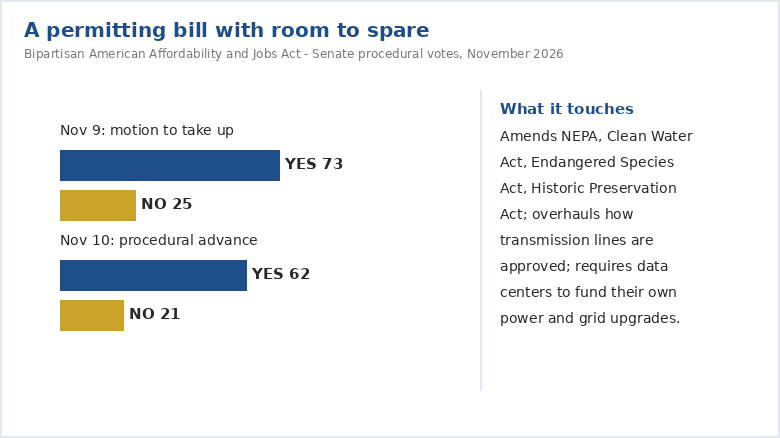
The Senate moved quickly on energy permitting last week. On Monday, November 9, senators voted 73-25 to take up the Bipartisan American Affordability and Jobs Act, and a second procedural vote Tuesday night advanced it 62-21, setting up an amendment process and further votes this coming week. The Associated Press described it as the first major legislative action since a midterm election that soundly repudiated the president's party - and noted the bill is being pushed as a way to meet electricity demand that now faces years-long delays getting to the grid. [1,2,3]
The coalition is unusual on both sides. The bill is a compromise between Democrats who want faster buildout of renewable energy and Republicans who want more fossil fuel projects and fewer regulatory delays. The White House backs it, though President Trump said Monday he would not approve any wind projects and that the legislation remains subject to negotiation. [2,3]
What the bill would actually change
Per CNBC's account, the legislation would amend the National Environmental Policy Act, the National Historic Preservation Act, the Clean Water Act and the Endangered Species Act to speed reviews for electricity generation and other big projects, and would overhaul how transmission lines are approved. It would also require artificial-intelligence companies and data center developers to pay their own way for the power and grid enhancements their demand creates. [3]
The friction points are specific, not generic. Several Democrats want changes to the National Historic Preservation Act language after tribes complained it would not give them adequate input. In the House, Energy and Commerce Chair Brett Guthrie has said he wants to change the provisions aimed at building out electric transmission - a section that could be key to Democratic support. The bill must still pass the House if it clears the Senate, and negotiators are trying to make it law before this Congress ends in January. [2,3]
Why this Congress, why now
Permitting overhaul efforts have circulated for years and repeatedly sputtered; CNBC reports negotiators believe this session is different because both parties now face the same visible constraint - demand. Data centers, electrification and industrial load have turned interconnection queues and multi-year reviews into a cost story that voters experience as utility bills. Senator Martin Heinrich, the top Democrat on the Energy and Natural Resources Committee, framed the bill squarely as an affordability measure. [1,3]
The election context cuts both ways. AP's reading is that a repudiated governing party and an incoming opposition have a shared incentive to show action on costs before January. That incentive is real but fragile: the same report notes the president's wind position and ongoing negotiation, and The Hill records reservations on both the tribal-input and transmission provisions. [1,2]
What business readers can watch next
Analysis: if anything like this passes, the first-order effect is time. Shorter review timelines and curtailed challenges change project math for generation and transmission developers - years shaved off approval are worth more than most subsidies. The transmission overhaul is the section with the largest system-wide cost implication, which is exactly why it is attracting House resistance. None of this is law yet; treat it as a live variable, not a planning assumption.
The data-center cost-allocation provision deserves attention from any large power user. A statutory rule that big new loads fund their own grid upgrades would formalize what utilities and regulators have been negotiating case by case. For commercial and industrial customers, that boundary decides whether data-center-driven grid costs show up in general rates. [3; analysis]
Observable markers: this week's amendment votes and any final Senate passage tally, the tribal-input language after the amendment process, the House posture on transmission, and whether the wind-permitting friction between the president and the bill's text gets resolved in writing. Each is a dated, public event. [analysis]
Sources and credits
Sources checked November 15, 2026. Educational reporting and labeled analysis, not investment, legal or policy advice. The legislation described is pending and may change; nothing here is a forecast of passage.
Contact Xyzenrgy to discuss the energy questions facing your business: [email protected].