 Xyzenrgy
Fifteen months from announcement to ticker
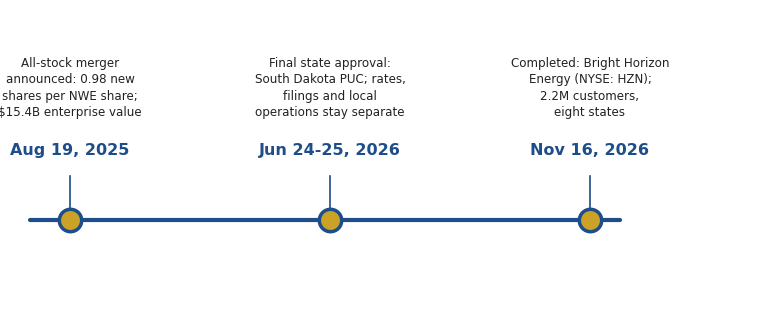
Black Hills Corp. and NorthWestern Energy completed their all-stock merger on Monday, November 16. Black Hills has changed its name to Bright Horizon Energy Corporation, and its shares now trade on the New York Stock Exchange under the ticker HZN; NorthWestern is a wholly owned subsidiary. Each NorthWestern share converted into 0.98 shares of the new company, with cash paid for fractional shares. [1]
The combined holding company serves 2.2 million electric and natural gas customers across eight states - Arkansas, Colorado, Iowa, Kansas, Montana, Nebraska, South Dakota and Wyoming - operating as Black Hills Energy and NorthWestern Energy. It is headquartered in Rapid City, South Dakota, and led by Brian Bird, formerly NorthWestern's chief executive; Black Hills CEO Linn Evans retired at closing. [1,2]
The deal was announced on August 19, 2025, at an enterprise value of $15.4 billion. The exchange ratio then valued NorthWestern's equity at roughly $3.6 billion, or $59.14 per share, and Black Hills shareholders ended up with about 56 percent of the combined company. [2]
Why utilities are merging
Reuters' reporting on the announcement framed the combination as a scale answer to surging electricity consumption: record demand driven by data centers supporting artificial intelligence and cryptocurrencies, alongside broader residential and commercial growth. Together the companies had planned $7.4 billion of capital investment through 2029 and said the merger would open additional growth opportunities. [2]
The companies projected the deal would add to earnings per share in its first year and support 5 to 7 percent long-term EPS growth, above the 4 to 6 percent each had previously forecast. One analyst covering the announcement, Chris Ellinghaus of Siebert Williams Shank, said the larger balance sheet helps fund the growth both companies already had in front of them. These are company projections and analyst commentary, not outcomes. [2]
The regulatory price of approval
The last state approval came from the South Dakota Public Utilities Commission on June 24, announced June 25. Chairman Chris Nelson was explicit about the legal standard: state law directs the commission to approve such mergers unless there is a likelihood of significant adverse impact to customers, and he described that as a low bar that staff nonetheless used to extract protections. [3]
The approved settlements leave current rates, terms and conditions unchanged; extend rate moratoriums; put merger-related costs on shareholders rather than customers; keep a local presence; and require the two operating utilities to continue operating and filing for rates separately. The commission will keep regulating Black Hills Energy and NorthWestern Energy individually - the merger changed the parent, not the state-by-state rate regulation. [3]
What it means for energy costs, investment and business
Analysis: the deal is best read as a financing strategy for a capex-heavy decade, not a cost-cutting one. The announced logic is that a bigger balance sheet funds grid and generation investment at the pace new demand requires. Whether customers eventually see savings depends on future rate cases in eight separate jurisdictions, because the settlement structure deliberately keeps the two utilities' rate bases apart. For the large commercial and industrial customers in that footprint, the near-term facts are the moratoriums and separate filings - not any promised merger synergy.
Analysis: for investors, the completion is a data point in regulated-utility consolidation as an answer to load growth: the projected accretion and the 5 to 7 percent growth guidance now have to be delivered against integration costs that the company's own forward-looking statement flags as a risk. For developers and large power users across the Plains and Rockies, a single holding company with a $7.4 billion planned capital program is a potentially deeper-pocketed counterparty for new load and new supply - while every dollar of that program still has to clear eight state commissions, one filing at a time.
Sources and credits
Sources checked November 16, 2026. Educational reporting and labeled analysis, not investment, legal or regulatory advice. Company projections and analyst views are attributed as such, not verified outcomes or forecasts by Xyzenrgy.
Contact Xyzenrgy to discuss the energy questions facing your business: [email protected].