 Xyzenrgy
The round
Project Omega, a nuclear recycling startup based in Newport, Rhode Island, announced an $80 million Series A on November 9, led by B Capital with participation from noa VC, 645 Ventures and existing investors including Starship Ventures, Mantis Ventures, Decisive Point, Virta Ventures, Pace Ventures, Essential Capital and Washington Harbour Partners. B Capital's Jeff Johnson joins the board. The company says the money will advance its X Series modular power products and begin construction of a nuclear fuel recycling pilot facility for isotope recovery and feedstock production. [1]
The company emerged from stealth eight months ago and works with federal laboratories: recycling technology development with Idaho National Laboratory through ARPA-E's CURIE program, a demonstrated stable electrical current from strontium-90 at Pacific Northwest National Laboratory, and radioisotope power system work under DARPA's Rads to Watts program. [1]
The technology and the products
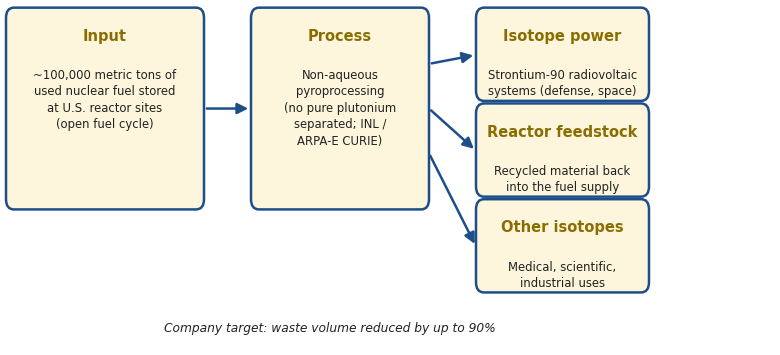
The United States runs an open fuel cycle: uranium is mined, enriched, used once, and stored at reactor sites. Project Omega wants to close that loop with non-aqueous pyroprocessing - an electrochemical separation method, as Argonne National Laboratory describes the technique - that recovers useful isotopes without separating pure plutonium. The company targets reducing waste volume by up to 90 percent. Its feedstock thesis rests on a large inventory: nearly 100,000 metric tons of used nuclear fuel already sitting in the United States. [1,2]
The first product focus is radiovoltaic power: solid-state systems that convert the natural decay of isotopes such as strontium-90 directly into electricity, built for missions where recharging or battery replacement is impractical - sensors, autonomous systems, communications nodes, spacecraft and undersea platforms. Founder and CEO Stafford Sheehan put the use case plainly at a defense forum this month: autonomous systems are only as capable as their energy supply, and batteries cannot be swapped on the ocean floor. [1,2]
Where the revenue is supposed to come from
The company describes three product lines from one feedstock: long-duration isotope power for defense, space and remote operations; recycled feedstock for nuclear reactors; and strategic isotopes for commercial, scientific and medical use, including cancer-treatment research. B Capital's Johnson framed the investment around multiple revenue streams from a largely untapped domestic resource. [1,2]
The strategic backdrop is supply security. The U.S. relies heavily on foreign sources for uranium on the front end of the fuel cycle while spending billions managing and storing used fuel at the back end - the asymmetry the company is built to exploit. [1]
What it means for energy costs, investment and business
Analysis: the economic proposition is to convert the back end of the fuel cycle from a pure cost center into a supply source. Every tonne of used fuel that yields saleable isotopes or feedstock is a tonne that utilities and the federal government are currently paying to store. That logic is why recycling keeps returning to U.S. energy policy debates; what is new here is venture-scale private funding aimed at defense and space niches that can pay early, rather than at utility-scale reprocessing economics first.
Analysis: the risks are equally concrete. The United States has no commercial pyroprocessing facility, so licensing, construction and first-of-a-kind operating risk all sit ahead of the pilot plant; the revenue lines beyond defense contracts are early; and the waste-reduction and cost figures are company targets, not demonstrated commercial performance. For the broader nuclear buildout, though, a credible domestic back end matters: every advanced reactor developer counting on U.S. fuel supply chains is implicitly counting on someone solving the fuel cycle's back half. This is one funded attempt to do it.
Sources and credits
Sources checked November 16, 2026. Educational reporting and labeled analysis, not investment or legal advice. Company targets, resource figures and program descriptions are the company's own statements, attributed as such - not verified outcomes or forecasts by Xyzenrgy.
Contact Xyzenrgy to discuss the energy questions facing your business: [email protected].