
A balance flips for the first time since the war
The IEA's November Oil Market Report, published November 13, records a turning point: global oil supplies surpassed demand in October for the first time since the outbreak of the war in Iran, and the agency's balances point to a market surplus in the fourth quarter of 2026 with a more substantial build in 2027. Observed global inventories rose by 52 million barrels in October, about 1.7 million barrels per day, the first increase since June. Oil on water surged by 86 million barrels to its highest level since January as Gulf crude exports recovered. [1]
The cushion is uneven. On-land stocks kept falling and are at their lowest since at least 2016, OECD total stocks declined by 47 million barrels with industry inventories down 41 million, and observed global stocks remain 462 million barrels below where they stood when the war began. The market is building again, but from a deep hole. [1]
Supply is recovering faster than demand
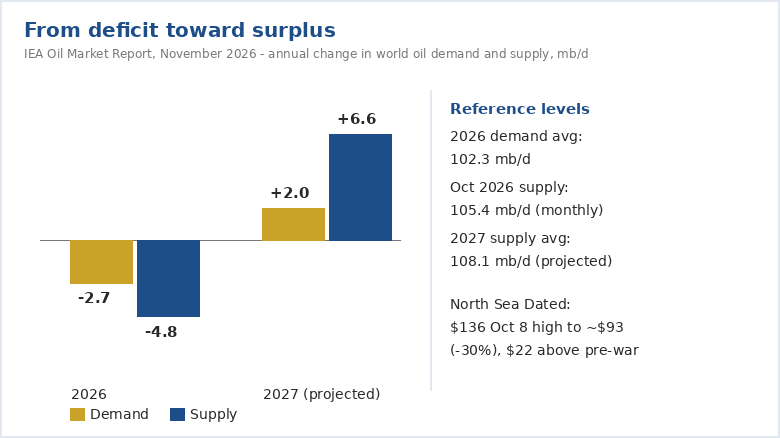
Global oil supply rose by 2.3 million barrels per day in October to 105.4 million, an extraordinary 5.3 million per day climb since August. Gulf exports excluding Oman reached 18.4 million barrels per day, still 26% below pre-war levels, but crude flows of 15 million per day were back to 82% of pre-war volume despite continued attacks on tankers. The rebound was strong enough for the IEA to raise its fourth-quarter supply estimate by 3.3 million barrels per day and trim the average 2026 decline to 4.8 million. [1]
Next year the agency projects supply recovering by 6.6 million barrels per day to an average 108.1 million, including 5.3 million from the Gulf. Producers outside the Gulf keep growing through the disruption: the Americas Quintet of the United States, Canada, Brazil, Argentina and Guyana is on track to add 1.6 million barrels per day this year and a further 1.1 million in 2027. [1]
Demand is still shrinking, but the worst is narrowing
World oil demand is forecast to fall by 2.7 million barrels per day in 2026, to 102.3 million, before rebounding by 2 million in 2027. The year-on-year contraction is set to narrow to 2.7 million per day in the fourth quarter, from declines of 5 million in the second quarter and 3.8 million in the third, and the IEA expects the shortfall versus 2025 levels to shift back to growth around March. [1]
The composition matters for business readers. Petrochemical feedstocks - LPG, ethane and naphtha, the products most disrupted by the war - account for roughly 80% of next year's demand gains as supply chains normalise. Road fuel demand rebounds far more modestly, with the IEA citing high prices, electrification and fuel efficiency gains across the global car fleet. Demand destruction from price, not just war, is now part of the baseline. [1]
Crude has eased; products are still the pinch
North Sea Dated crude plunged more than 30% from its $136 per barrel high on October 8 to around $93 at the time of the report - still $22 above pre-war levels. Market reporting on November 13 shows prices remain sensitive to whether the conflict lingers, so the decline is a repricing of risk, not an all-clear. [1,3]
The overriding concern the IEA flags is not crude but products, especially diesel. Persistent attacks on Russian energy infrastructure continue to choke the country's diesel supplies to international markets, compounding Middle East losses. Atlantic Basin refineries, particularly in the United States, are running hard to capture high margins, record freight costs are squeezing Asian refiners, and fresh Chinese product export quotas could lift throughput there. The accelerated release of IEA emergency diesel stocks over the coming months is intended to bridge the gap until refinery output recovers. [1]
What business readers can watch next
Analysis: a surplus in crude balances does not automatically mean cheaper energy bills. The war's legacy sits in products and freight: diesel availability, shipping insurance and refinery margins can stay tight, and expensive, even as crude inventories rebuild. Businesses budgeting fuel and logistics costs for 2027 should treat crude-price relief and product-price relief as two separate questions. That is mechanism, not a price forecast.
The surplus itself is conditional. The IEA's own caveat is that attacks on shipping undermine the maritime security a sustained recovery depends on, and Gulf exports remain a quarter below pre-war levels. A market can move from surplus back to shortage faster than annual contracts reprice. [1; analysis]
Observable markers beat headlines: weekly inventory data against the 2016-era on-land lows, Gulf crude export flows against the 82%-of-pre-war recovery line, diesel cracks and emergency stock release volumes, Chinese product export quota usage, and the Americas Quintet supply additions. Each is published on a regular cadence by the organizations cited above. [analysis]
Sources and credits
[3] Yahoo Finance, November 13, 2026: Crude Prices Supported by Concerns US-Iran War Will Linger.
Sources checked November 14, 2026. Educational reporting and labeled analysis, not investment, procurement or legal advice. Projections are the IEA's published forecasts, attributed as such, not forecasts by Xyzenrgy.
Contact Xyzenrgy to discuss the energy questions facing your business: [email protected].