
A request for information, not a project
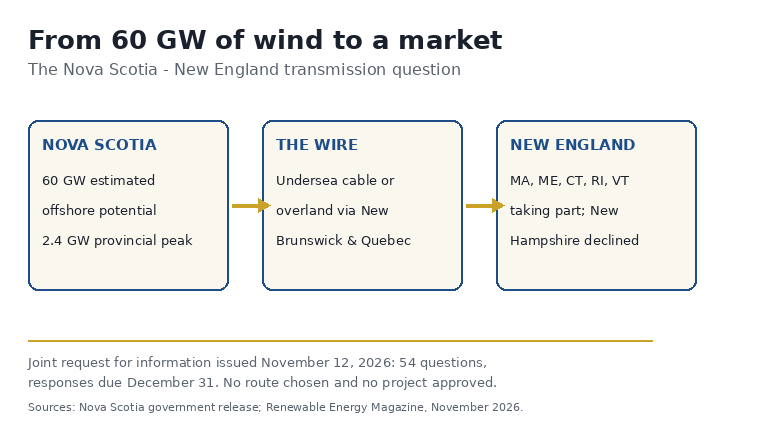
Nova Scotia and Massachusetts issued a joint request for information on offshore wind on November 12, with Maine, Connecticut, Rhode Island and Vermont also taking part; New Hampshire is the only New England state that declined. The document runs to 54 questions and asks developers, utilities, Indigenous communities, fisheries representatives, labour organizations, researchers, supply chain companies and environmental groups about market interest, transmission options, workforce needs and the infrastructure required to move power from potential Nova Scotia wind projects to New England consumers. Responses are due December 31. [1,2]
The RFI is the first concrete step under a memorandum of understanding signed by Nova Scotia Premier Tim Houston and Massachusetts Governor Maura Healey in February. Neither government has chosen a route, committed to a project or said what decisions will follow the December 31 deadline. An RFI gathers proposals; it approves nothing. [1,2]
The resource Nova Scotia wants to sell
The province's case rests on scale. The government estimates 60 gigawatts of offshore wind potential off Nova Scotia, against a provincial peak demand of 2.4 gigawatts, with annual average wind speeds above nine to eleven metres per second. Houston framed the geography plainly: "Nova Scotia is no longer at the end of the energy transmission line. We are becoming the starting point." [1]
Trade with the region already runs one way. In 2025, Nova Scotia exports to the New England states reached almost $1.2 billion, against imports of more than $57 million. Electricity would deepen that imbalance deliberately. [1]
The routes on the table
The RFI asks about two families of connections: undersea cables direct to New England, and overland lines running through New Brunswick and Quebec. Each carries a different permitting map, cost structure and set of counterparties, and each crosses the U.S.-Canada border, which adds federal regulators in both countries to the state and provincial processes. [2]
The context matters as much as the geography. U.S. offshore wind developers face federal permitting and leasing uncertainty and White House opposition to wind projects, which has complicated the project pipeline Massachusetts once expected to draw on. A Canadian resource with an Atlantic route to market is partly an answer to that uncertainty. [2]
What it means for costs, investment and business
Analysis: for New England buyers, the proposition is supply diversification. Imported Canadian wind power would compete with delayed domestic offshore projects and with the region's existing Canadian imports of hydroelectricity, and its effect on rates would depend on the transmission cost allocation that no one has proposed yet. For Nova Scotia, the model is export-led development: build generation sized to other people's markets, and let the cable be the business. Quebec has run versions of that model for decades.
Analysis: the investable pieces, if the RFI draws serious responses, are the wire before the wind. Transmission developers, cable manufacturers, marine survey and installation contractors, and port infrastructure on both sides of the border would see work before any turbine is financed. The 60 gigawatt figure is a resource estimate, not a project pipeline; what converts it into investment is a route, a cost-sharing agreement and creditworthy buyers, none of which exists yet.
What to watch between now and December 31
Analysis: the response list itself will be the first signal. Filings from incumbent utilities, established transmission developers and offshore wind majors would indicate a market taking the idea seriously; a thin response would say the opposite. Beyond the deadline, watch for the follow-on process the governments choose - a formal solicitation, a bilateral transmission negotiation or nothing - and for the U.S. federal posture toward cross-border clean energy infrastructure, which this project cannot route around. These are observable events, not predictions.
Sources and credits
Sources checked November 17, 2026. Educational reporting and labeled analysis, not investment, legal or regulatory advice. Resource estimates are government figures attributed as such, not verified outcomes or forecasts by Xyzenrgy.
Contact Xyzenrgy to discuss the energy questions facing your business: [email protected].