 Xyzenrgy
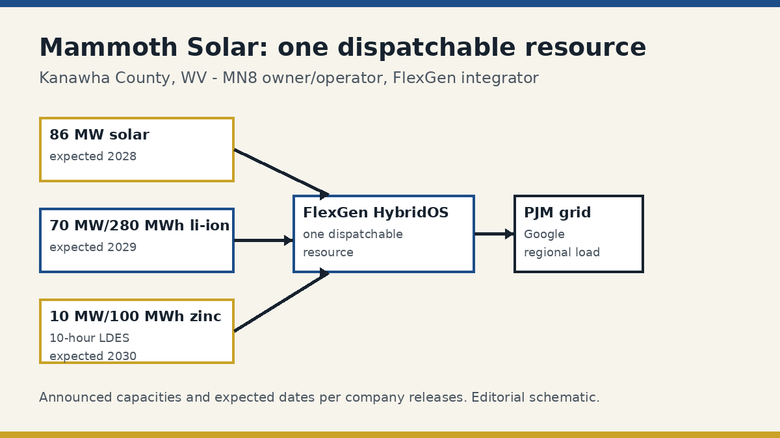
One resource built from three technologies
On November 11, FlexGen Power Systems announced it will serve as system integrator for MN8 Energy's Mammoth Solar campus in Kanawha County, West Virginia. The project combines 86 MW of utility-scale solar, 70 MW/280 MWh of lithium-ion battery storage and 10 MW/100 MWh of Eos Energy Enterprises' Z3 zinc-based long-duration storage, engineered to run as a single dispatchable resource rather than three adjacent assets. It is the first utility-scale zinc-based long-duration energy storage deployment in West Virginia. [1,2]
The design goal is to convert intermittent solar generation into power available across more hours of the day. The zinc system is built for 10 hours of discharge, extending solar output beyond what the shorter-duration lithium-ion batteries cover. The companies expect the solar portion to reach commercial operation in 2028, with lithium-ion storage following in 2029 and the zinc system in 2030. Those are expected dates for a project under development, not operating capacity today. [1,3]
The integrator is the product
FlexGen's role is not to supply batteries but to make dissimilar hardware behave as one plant. Its HybridOS energy management software handles control, analytics and dispatch across the three technologies. Through what FlexGen calls One Touch Commissioning, critical system integrations are tested and validated at its North Carolina lab before hardware ships to the site, and its Remote Operations Center supports commissioning overnight when field teams are off-site. The company cites more than 13 million hours of runtime on its codebase. [1]
Analysis: this layer is where hybrid projects succeed or fail. Pairing a four-hour lithium battery with a ten-hour zinc system and a solar array means reconciling different chemistries, response times, degradation profiles and warranties under one dispatch logic. An integrator that resolves those conflicts in a lab before equipment reaches the field is selling schedule certainty, which for large power buyers can be worth as much as the hardware. The announced award is evidence that developers now treat that coordination as a distinct, contracted discipline.
A hyperscaler anchors the revenue
MN8, the owner-operator, announced the project on September 2 alongside Google and Eos. Google will purchase the project's energy, capacity and clean energy attributes, and the integrated portfolio is designed to deliver power matched to data-center load profiles, serving Google's facilities in the region including a planned West Virginia project. It is Google's first project using Eos' Z3 technology and the first under the MN8-Eos Master Supply Agreement announced last October, which covers up to 750 MWh of zinc modules. [3,4]
The market backdrop explains why a buyer would contract this shape of supply. The project sits in PJM, where Utility Dive reports recent capacity auctions have hit the price ceiling and a one-time backstop auction this fall is set to fill a nearly 7 GW shortfall. Google has separately announced an expanded agreement with Voltus to build a 1 GW virtual power plant in PJM. Large buyers are assembling portfolios of supply, storage and flexibility rather than relying on any single mechanism. [2,4]
The economics, with the labels on
MN8 estimates the project represents up to $350 million in capital investment, approximately $4 million in property tax revenue for the county and local schools over the first 20 years, and around 200 construction jobs. The site is a reclaimed coal mine. These are the developer's own estimates for a project still years from completion, not audited outcomes. [3]
Scale context matters for the zinc component. Most operational zinc battery deployments in the United States have power ratings of 1 MW or less, according to Department of Energy figures cited by Utility Dive; the largest recent example was a 3 MW/12 MWh system installed by Lincoln Electric System this summer. A 10 MW/100 MWh commercial deployment is therefore a genuine scale-up, which is the point of the project and also its risk. No power-purchase price or per-megawatt-hour project cost has been disclosed, so outside observers cannot yet calculate the economics of the round-the-clock supply being promised. [4; analysis]
Eos, the zinc-battery manufacturer, is publicly traded (NASDAQ: EOSE) and produces its systems in Pittsburgh. Its chemistry is aqueous, non-flammable and uses non-precious materials, attributes the company positions against lithium-ion for long-duration use. These are manufacturer claims with a commercial interest behind them; the project's staged 2029-2030 storage completion dates mean performance at this scale remains to be demonstrated. [3,4]
What business readers can watch next
Analysis: for energy costs, the question this project tests is whether pairing long-duration storage with solar can deliver dependable capacity at a price large buyers will pay without subsidy-shaped contracts. If it works at Mammoth Solar, the template travels to any region where data-center or industrial growth outruns grid capacity. If the zinc system slips or underperforms, buyers learn the same lesson more cheaply here than on their own balance sheets.
For investment and business opportunity, the signal is where value concentrates: integration software and commissioning expertise, long-duration storage manufacturing, and developers holding interconnection positions in constrained markets like PJM. The MN8-Eos master agreement's 750 MWh pipeline suggests the partners intend replication, not a one-off showcase. [3,4; analysis]
Concrete markers to track: whether the solar portion holds its 2028 commercial-operation date, FlexGen's commissioning milestones as hardware arrives, Eos' delivery record against the master supply agreement, and PJM capacity auction results that set the revenue backdrop. Announced capacity and delivered capacity are different columns, and this project will fill them in over four years.
Sources and credits
Sources checked November 14, 2026. Educational reporting and labeled analysis, not investment or procurement advice. Company estimates and expected dates are attributed to their sources, not guarantees or forecasts by Xyzenrgy.
Contact Xyzenrgy to discuss the energy questions facing your business: [email protected].