 Xyzenrgy
A backlog appears
Fervo Energy's third-quarter results, published November 9, mark the moment enhanced geothermal stopped being a pilot story. The company declared commercial operation at Cape Station's GeoBlock 1 on September 30 - ahead of its contractual date - and the 33-megawatt block is delivering power under its power purchase agreement in line with expectations. GeoBlock 2 has achieved grid sync and is delivering test energy; GeoBlock 3 is mechanically complete and in cold commissioning. Both are expected to reach commercial operation by January 1, 2027, completing the roughly 100-megawatt Phase I. [1]
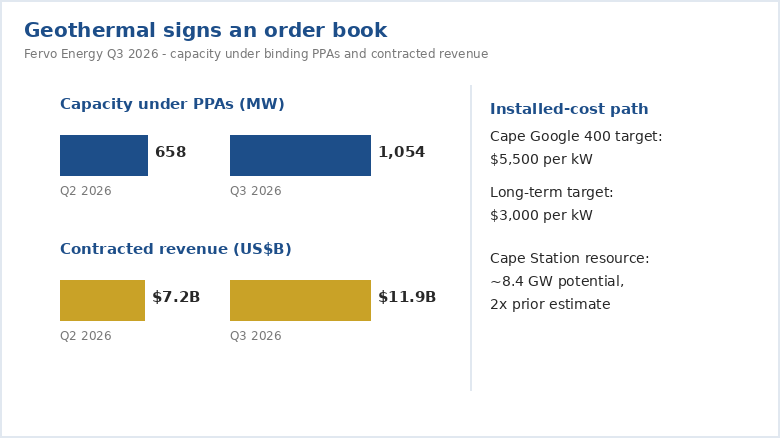
The bigger number is the order book. With a new agreement Fervo describes as the largest enhanced geothermal PPA to date, signed with Google, the company now has 1,054 megawatts under binding PPAs representing approximately $11.9 billion in contracted revenue - up from 658 megawatts and about $7.2 billion at the end of June. The Google blocks, GeoBlocks 4 through 11, are now called Cape Google 400 and are expected to deliver roughly 400 megawatts beginning in 2028. [1,2]
The resource got bigger, the cost target lower
An updated heat-initially-in-place study by DeGolyer and MacNaughton, commissioned by Fervo this quarter, supports approximately 8.4 gigawatts of capacity potential at Cape Station - nearly double the prior 4.3 gigawatt estimate - driven by the company's deeper 3.0 well design and added leases. That is a resource estimate, not built capacity. [1]
On cost, Fervo is targeting an installed cost of $5,500 per kilowatt for Cape Google 400, on a stated path to $3,000 per kilowatt long term, using longer laterals, larger casing and deeper targets to raise output per well. The physical build is tracking: the first 50-megawatt turbines passed factory acceptance testing, over 60 percent of air-cooled condensers are on site, and drilling for the Google blocks is about 18 percent complete. [1]
Money in, and where it goes
The build is capital-heavy. Q3 capital expenditures were $256.7 million, up from $226.5 million in Q2, and the company expects $450 to $500 million in Q4 - but it lowered second-half guidance to $700-$750 million from $850-$900 million, attributing the change to construction efficiencies moving spend later in the cycle with no change to expected operation dates or total investment. Fervo ended the quarter with $1.9 billion in unrestricted cash against $301.6 million in debt. Q3 net income of $11.7 million included $15.4 million of interest income and two non-recurring items - an $11.8 million swap gain and a $29.9 million tax-credit benefit; the net loss attributable to common stockholders was $20.8 million. Q4 will be the first full quarter of revenue from Cape Station. [1]
Two potential DOE awards totaling about $20 million, for appraisal wells in Idaho and Nevada, remain subject to definitive funding agreements. The wider pipeline: 36 megawatts operating, 466 under construction, 550 ready to build, 3.0 gigawatts in advanced development and roughly 54.7 gigawatts in early development. [1]
The oilfield is the supply chain
Enhanced geothermal runs on drilling, and the industry's incumbents are showing up. Sage Geosystems selected Halliburton to provide cementing and stimulation services at Project Vector, its geopressured geothermal project in Nevada, with Halliburton explicitly framing the work as applying its oilfield technology and experience. The same crossover is visible in Fervo's results: its cost reductions come from shale-style drilling iteration, and its schedule confidence comes from oilfield-style factory acceptance and delivery discipline. [1,3]
What business readers can watch next
Analysis: the significance of an $11.9 billion contracted backlog is that it converts geothermal from a technology risk into an execution risk. A buyer signing a 400-megawatt PPA is betting on drilling schedules, not physics. For large power buyers, firm clean generation with a stated installed-cost path toward $3,000 per kilowatt is a real planning alternative to watch alongside gas, nuclear and storage - on cost targets and timelines that remain targets, not proven fleet averages.
For energy businesses, the investable signal is the supplier layer: stimulation, cementing, turbines and cooling equipment are booking geothermal revenue now, whatever happens to any single developer. And for anyone budgeting 2028 power, the Cape Google 400 in-service date is a checkable milestone, not a promise. [analysis]
Observable markers: GeoBlocks 2 and 3 reaching commercial operation by January 1, Fervo's first full revenue quarter in Q4 results, drilling progress on the Google blocks against the 2028 start, whether the $5,500 per kilowatt target holds as Cape Google 400 completes, and further oilfield-services contracts like Halliburton's. Each is dated and public. [analysis]
Sources and credits
[2] TechCrunch, November 9, 2026: Fervo now has $12B in orders for its geothermal power tech.
Sources checked November 15, 2026. Educational reporting and labeled analysis, not investment, procurement or legal advice. Company targets, resource estimates and guidance are the companies' own statements, attributed as such - not verified outcomes or forecasts by Xyzenrgy.
Contact Xyzenrgy to discuss the energy questions facing your business: [email protected].