
What was announced
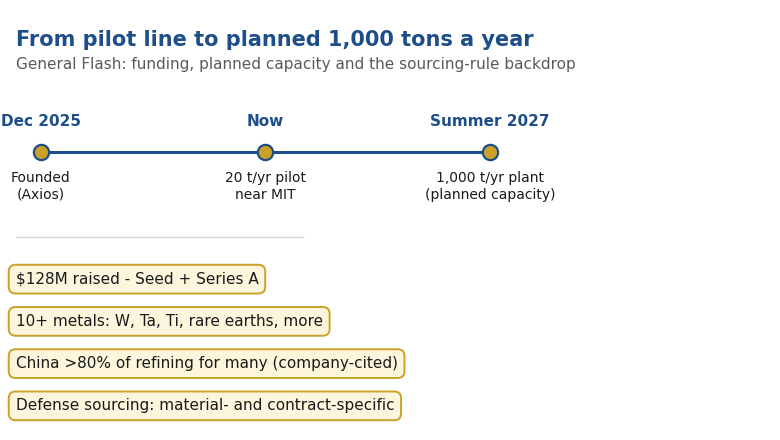
General Flash announced on November 17 that it has raised $128 million in equity capital across its Seed and Series A rounds. Investors include Lux Capital, Construct Capital, Overmatch Ventures, GreatPoint Ventures, Pillar VC, Lowercarbon Capital, Ensemble VC, Ravelin and angel investors. [1,2]
The company's process, which it calls Solid-State Flash Electrolysis, converts metal oxides directly into high-purity, semiconductor-grade metal. General Flash describes it as energy-efficient, emissions-free, and faster and lower cost than conventional refining - all company characterizations. It says the process is metal-agnostic, covering tungsten, tantalum, titanium, hafnium, zirconium, germanium, yttrium, niobium, molybdenum and rare earth elements. [1]
From a pilot line to a plant
The company operates a 20-metric-ton-per-year pilot facility near MIT. The new funding targets commercial-scale production by summer 2027, at 1,000 metric tons per year; chief executive Ric Fulop said the raise "fully finances production of our first large plant in the U.S." The company calls the planned facility one of the largest and most advanced critical materials production plants in the world, its own description of a plant not yet built. [1]
Axios reports the manufacturing plant is planned elsewhere in Massachusetts, with further capacity expansion intended for Texas. Early customers are expected to be government entities such as the Department of Defense and the Department of Energy, with dual-use commercial sales to follow, according to Fulop. [2]
The policy clock behind the raise
The company's case rests on a supply-chain fact pattern it cites directly: China accounts for more than 80 percent of refining capacity for many critical metals, even where the ores are mined elsewhere, and the United States let production of these materials move overseas after developing most of the underlying techniques in the twentieth century. [1]
The policy backdrop is narrower than a general ban on Chinese critical metals. Under 10 U.S.C. 4872, covered materials include specified magnets, tantalum, tungsten products and molybdenum. The covered countries are China, Russia, Iran and North Korea. An amendment effective January 1, 2027 adds a restriction on entering contracts for covered material mined, refined or separated in those countries. Exceptions and authorized waivers apply. Germanium and gallium additions have a separate December 2027 effective date. [3]
Contract language also matters. The older DFARS 252.225-7052 clause uses a January 2027 delivery-date restriction. Pillsbury's October 21 analysis describes a 2026 replacement clause, 252.225-7961, that instead ties the expanded upstream restriction to contract award, and warns that existing agreements do not change automatically. The company's broad description of the policy is not a substitute for checking the material, contract clause, award date and applicable exceptions. [4,5]
The founder and the backers
Fulop launched General Flash last December, Axios reports. He previously founded lithium-ion battery maker A123 Systems and 3D-printing company Desktop Metal. His own analogy for the moment: aluminum was once more expensive than gold - the Washington Monument's cap is aluminum because it was then a precious metal - until a new production technique made it cheap. [2]
Investors are selling the same thesis. Lux Capital's Peter Hebert cited "a genuinely new process, proven at pilot scale, and a founder who has built and scaled a manufacturing company before." Construct Capital's Dayna Grayson framed it as a new company in a foundational industry that rarely sprouts them. These are the backers' statements, from the company's own release. [1]
What it means for costs, investment and opportunity
Analysis: tighter sourcing restrictions can make compliant refining capacity more relevant to defense buyers. They do not reserve orders for General Flash, require U.S.-only sourcing, or guarantee a demand floor. The company's cost, purity, energy-use and emissions claims still need testing at commercial throughput; pilot performance and investor backing do not establish those outcomes. [1,3,5]
Analysis: the reported route to market begins with expected government buyers, a planned Massachusetts plant and possible later Texas expansion. Watch for named customers, commercial-throughput evidence and progress against the summer 2027 target. The plant and customer plans remain prospective, not verified operating results. [1,2]
Sources and credits
Sources checked November 18, 2026. Educational reporting and labeled analysis, not investment advice. Process performance, emissions, cost and production-timeline statements are the company's; funding and investor details come from the company's release and Axios reporting. Nothing here is a forecast of the company's results.
Contact Xyzenrgy to discuss the energy questions facing your business: [email protected].