
A record year, counted
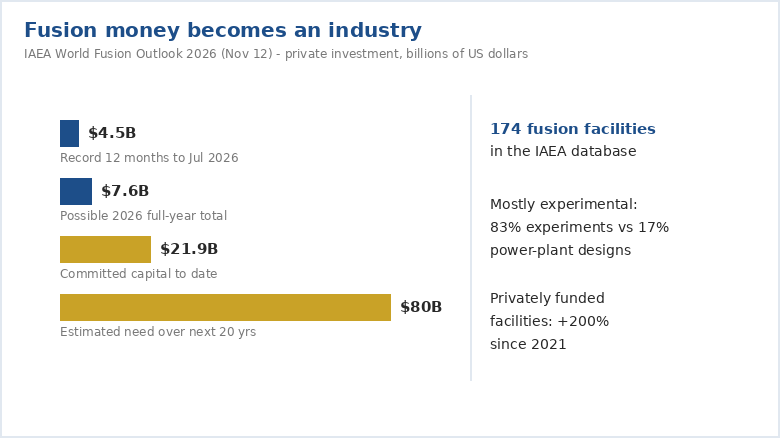
On November 12, the International Atomic Energy Agency released its World Fusion Outlook 2026, the fourth edition of the report, at the third High-Level Meeting of the World Fusion Energy Group in Vienna. The headline number: private fusion companies raised a record $4.5 billion in the 12 months to July 2026, bringing cumulative funding since 2021 past $14 billion, drawing on Fusion Industry Association data. FusionX, an industry "ecosystem builder" contributing to the report, puts total committed private capital higher still at $21.9 billion - more than 90% of it raised in the past five years - and estimates investment could reach a record $7.6 billion for 2026 as a whole. [1,2]
The IAEA's framing is that fusion is in a crucial transitional phase: experimental machines are becoming integrated facilities, plant concepts are becoming industrial programmes, and a global supply chain is emerging. Perspective matters alongside the records: private money still accounts for only 36% of all fusion investment, with public funding at 64%. There was a time when effectively all of it was public. [2]
The money is turning into purchase orders
The clearest sign of industrialization is spending, not fundraising. Private fusion companies spent more than $350 million with suppliers last year, and there are now 92 private fusion companies worldwide. Commonwealth Fusion Systems, the best-capitalized of them, raised $1 billion in July, bringing its total to $4 billion, which CEO Bob Mumgaard says is enough to build its prototype and prepare a larger utility-scale plant for the early 2030s. Abu Dhabi's government-owned fusion fund Plynth Energy took a minority stake worth more than $100 million this year. Notably, when CFS needed large metal components and complex machinery, it turned to suppliers from the oil and gas industry. [2,4]
Europe's Proxima Fusion signed memoranda with two Japanese industrial partners in Tokyo on October 28, in front of the German chancellor and Japanese prime minister: Fujikura, to explore industrial-scale manufacturing in Germany of high-temperature superconducting tape, and Kyoto Fusioneering, to extend work on gyrotrons that heat plasma. Proxima's planned 140 million euro facility would be financed partly from a $468 million July round that valued the Google-backed company at $2.7 billion. [3]
The bottlenecks are physical, not theoretical
The same report that counts record money also counts the gaps. High-temperature superconducting tape - the specialized material behind the leading magnetic-confinement designs - has only a small number of manufacturers worldwide, which is exactly why Proxima is trying to build capacity in Germany. The IAEA identifies developing supply-chain gaps, including manufacturing capacity, as a central risk to commercialization, and notes countries are still writing the regulatory frameworks fusion will be built under. [2,3]
The IAEA's Fusion Facility Database now lists 174 fusion facilities worldwide. Most are experiments rather than power-plant designs - 83% versus 17% in the published account - and the number of privately funded fusion facilities has grown 200% since 2021. The build-out is real; it is also early. [2]
What the outlook does and does not promise
FusionX estimates commercializing fusion will require another $80 billion of private investment over the next 20 years, in different forms and from different sources than the venture rounds so far, and expects consolidation among the 92 companies. No fusion plant sells power to a grid today, and the report does not claim one does. [2]
An EUROfusion study adapted for the report is equally careful about the long term: fusion's contribution to the energy mix will depend more on the pace of deployment and scale-up than on when the first commercial plants begin operating. Depending on assumptions about timing, capital costs, deployment rates and renewable integration, fusion could supply from a few percent to as much as 15-20% of global electricity by the end of the century. That is a scenario range, not a forecast. [2]
What business readers can watch next
Analysis: the near-term business relevance of fusion is not power bills; nothing in this report changes an energy procurement decision for 2027. What is concrete today is the industrial layer around it - superconducting tape and magnet manufacturing, precision components, gyrotrons and power electronics, and the oil-and-gas supply chains CFS is already buying from. The report's own marker of that shift: private fusion companies spent more than $350 million with suppliers last year. [2; analysis]
The investment pattern itself is information. Sovereign capital (Abu Dhabi's Plynth), strategic tech investors (Google backing both CFS-linked and Proxima ecosystems) and government milestone programs are converging on the same bet, while expecting consolidation. For energy strategists, fusion belongs in long-range scenario planning - the EUROfusion range says why - not in current capacity planning. [analysis]
Observable markers: HTS tape manufacturing capacity commitments like the Fujikura-Proxima agreement, the first utility-scale plant financing structures after CFS's prototype, regulatory framework decisions in the US, UK, Germany and Japan, first industrial offtake or power-purchase agreements, and which of the 92 companies survive the expected consolidation. Each is a dated, checkable event rather than a sentiment. [analysis]
Sources and credits
Sources checked November 14, 2026. Educational reporting and labeled analysis, not investment, procurement or legal advice. Scenarios and capital estimates are attributed to their publishing organizations, not forecasts or endorsements by Xyzenrgy.
Contact Xyzenrgy to discuss the energy questions facing your business: [email protected].