 Xyzenrgy
A smaller cushion than usual
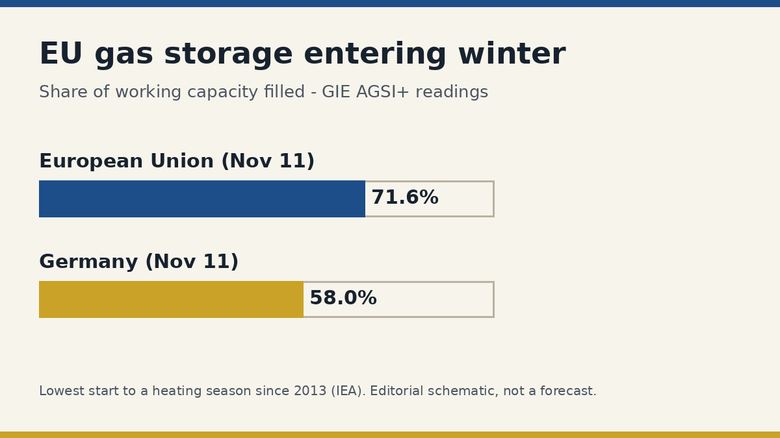
Europe has started the heating season with less gas in reserve than at any point in more than a decade. EU storage sites were 71.6% full in Gas Infrastructure Europe's November 11 update, with Germany at 58%, well under the five-year average for this point in the season. A dashboard reading of the same AGSI+ data put the EU at 71.0% on gas day November 12, or 804 of 1,132 TWh, with Poland fullest at 96.1% and Germany emptiest among seven compared markets at 57.6%. Three of those seven markets sat below their usual five-year range for the date. [2,3]
The IEA's Global Gas Security Review 2026, published November 3, describes the same position: EU inventories entering the 2026-27 heating season at their lowest levels since 2013. Storage is the region's shock absorber for cold snaps and supply interruptions. A lower starting level means more reliance on buying LNG cargoes during the winter itself, when competition for them is strongest. [1]
A supply shock sits underneath
The immediate cause is the effective halt of LNG flows through the Strait of Hormuz during the current Middle East conflict. The IEA calculates that reduced loadings from Qatar and the United Arab Emirates removed more than 60 billion cubic metres of supply between March and October, driving Asian and European prices to their highest since the 2022-23 gas crisis. Kpler tracking put Qatar's October exports just above 2.7 million tons, against nearly 6.2 million in February; QatarEnergy, which said in March that attacks had cut 17% of its export capacity, has extended force majeure through at least the end of December. [1,2]
Shipping data shows how fragile the remaining flow is. S&P Global tracking cited by Reuters counted 31 laden LNG tankers leaving the strait in October, up from 23 in September and the busiest month since February, while the Washington Institute for Near East Policy counted 37 ships struck over the same month. Asian spot LNG traded above $30 per million Btu, and European front-month TTF reached 88.42 euros per megawatt-hour on Thursday morning, up 2% and rising for a third session. [2]
A more flexible market is absorbing part of the hit
The IEA's central finding is not simply that supply was lost; it is that the market has changed shape since the 2022-23 crisis. A decade of growth in spot trading and destination-flexible LNG contracts has made regional markets more interconnected, letting cargoes move to where prices pull them. Supply from outside the Gulf has made up about two-thirds of the lost Qatari and Emirati volumes since March, with North American growth doing much of the work. [1]
Flexibility has limits. The IEA still projects global LNG supply will fall 3% in 2026, almost 20 bcm, the steepest drop on record, while global gas demand declines about 1.5%, or close to 65 bcm, on Middle East demand destruction, weaker European industrial consumption and gas-to-coal switching in Asian power sectors. Looking further out, the agency puts cumulative LNG supply losses from 2026 to 2030 at 150 bcm, equal to 15% of the new supply expected globally over that period, and sees no meaningful relief before the end of the decade. These are the IEA's published projections, not this publication's forecasts. [1]
Winter outcomes run both ways
The downside case is specific. The IEA modeled a cold winter combined with continued Hormuz disruption and found EU storage could fall below 10% of working capacity by the end of March, S&P Global reported. A late cold snap would arrive when withdrawal rates, which slow as sites empty, are least able to respond. That is a modeled scenario, not a prediction. [2]
Rystad Energy's winter LNG outlook, published this week, lays out as many ways for prices to fall as to rise and advises buyers to plan for a range rather than one base case. Its mild-winter expectation for Northeast Asia would mute the strongest bidder: Bernstein calculated that a super El Nino would cut Japan's winter heating demand by 19% but its LNG consumption by only 2%. China is already price-sensitive, with Bloomberg reporting cheap domestic supply holding the national average LNG price near $22, almost $10 below the Japan/Korea Marker. Rystad also notes transits stabilized in October and supply could recover by the second quarter of 2027, while cautioning that output remains, in its words, one escalation away from cratering again. [2]
The United States reads like a separate market. The EIA's November 10 outlook has Henry Hub averaging $2.87 per million Btu from November through March, 16% below the prior month's forecast, with export terminals running near full capacity; Rystad expects a winter peak around $4. American gas is largely cut off from the global rally, though that insulation also means US export capacity is one of the levers Europe is counting on. [2]
What business readers can watch next
Analysis: for European industrial gas and power buyers, the practical exposure is procurement timing in a thin-buffer winter. A market that must buy cargoes during cold spells, rather than draw them from storage, pays winter prices at winter speed. Contract flexibility, interruptible-demand options and power-price hedging matter more when the cushion is small; none of that is a recommendation, only the mechanism now in play.
The summer of 2027 is part of the winter story. The IEA warns that low end-of-winter storage would substantially raise injection needs through summer 2027, extending global tightness well into next year. Businesses budgeting energy costs on the assumption that relief arrives with spring should note that refill demand itself competes for the same cargoes. [1; analysis]
Five observable markers will say more than any headline: weekly GIE AGSI+ withdrawal rates against the five-year range, laden-tanker transits through Hormuz, the status of QatarEnergy's force majeure after December, the TTF-versus-JKM spread that decides where flexible cargoes land, and Northeast Asian weather. Each is published on a regular cadence by the organizations cited above. [analysis]
None of this requires alarm to be useful. Europe enters winter with real buffers, a more flexible market than it had in 2022 and multiple paths to a mild outcome. It also enters with less margin for error than at any time since 2013. Both facts belong in the same plan.
Sources and credits
Sources checked November 14, 2026. Educational reporting and labeled analysis, not investment, procurement or legal advice. Scenarios and projections are attributed to their publishing organizations, not forecasts by Xyzenrgy.
Contact Xyzenrgy to discuss the energy questions facing your business: [email protected].