 Xyzenrgy
Energy is now a financial variable
For a large energy-consuming enterprise, energy used to be a bill you paid and forgot. That era is over. This week, Asian spot LNG traded above $30 per million Btu and European front-month gas reached 88.42 euros per megawatt-hour, with Europe entering winter with its lowest storage levels since 2013 after an effective halt of LNG flows through the Strait of Hormuz removed more than 60 billion cubic metres of supply between March and October. In the United States, the EIA cut its winter Henry Hub forecast by 16% in a single month, to an average of $2.87 from November through March. In PJM, the largest US power market, recent capacity auctions hit the price ceiling and regulators scheduled a backstop auction to fill a nearly 7 GW shortfall. [1,2,3]
None of these numbers sit in a distant commodity market. They flow into the electricity and gas contracts that manufacturers, logistics operators, data centers, universities and hospital systems sign. When the underlying market can move 16% on a forecast revision, the difference between a managed and an unmanaged energy position shows up directly in operating margin. [analysis]
The cost is in the contract details
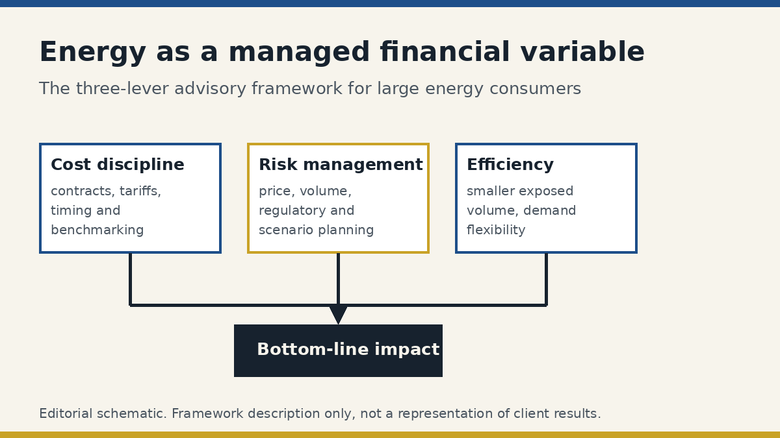
Energy spend is rarely lost on the headline price alone. It leaks through contract mechanics: minimum-take and capacity-band floors, demand ratchets, bandwidth and swing provisions, index-versus-fixed structures, renewal timing and exit conditions. Utility tariff structures change too. New large-load tariffs being filed across the country introduce their own minimum-demand obligations and conditional exit terms, and the details differ by capacity band and by state. An enterprise that signs what is put in front of it accepts whatever those details cost. [analysis]
On a small bill these details are rounding. On a large load they are material. A single-digit percentage difference on a multi-million-dollar annual energy spend is real money, and it recurs every year the same terms roll forward. The discipline of reading, benchmarking and timing contracts is where an advisor earns their fee - not in predicting the market, which nobody does reliably, but in making sure the enterprise is not structurally overpaying. [analysis]
Risk management is a discipline, not a product
Energy risk is several exposures at once: price risk on uncontracted volumes, volume risk when operations expand or contract, regulatory risk as tariffs and rules are rewritten, and counterparty risk on the suppliers themselves. This winter illustrates the point. Europe could see a cold snap drain storage below 10% of working capacity by end of March in the IEA's modeled downside case, or a mild winter in Asia could soften prices instead; forecasters at Rystad Energy explicitly advise planning for a range rather than one base case. [1,2]
A financially risk-managed strategy treats those exposures deliberately: knowing which volumes are fixed and which float, when contracts expire and what the renewal calendar looks like, what happens to the budget in a high-price scenario and a low one, and which decisions belong to procurement, treasury or the board. The goal is not to eliminate risk, which is impossible, but to choose which risks the business carries knowingly. [analysis]
Efficiency is the quietest lever
Every megawatt-hour an enterprise does not consume is one it does not have to buy at winter prices. Efficiency rarely carries the drama of a market rally, but it compounds: lower consumption shrinks the exposed volume that every price swing multiplies. For large consumers, efficiency review belongs in the same conversation as supply strategy, because the cheapest risk reduction is often a smaller position. [analysis]
The same logic applies to flexibility. Where markets and tariffs allow, the ability to shift or trim demand at expensive hours has measurable value, and that value is rising as capacity costs climb in markets like PJM. [3; analysis]
Enterprises that staff energy as a function
Some of the world's largest energy consumers already run energy as a staffed corporate function, and their results are public. Corporate energy buyers contracted a record 21.7 gigawatts of renewable energy in 2024, lifting cumulative corporate-supported additions to the U.S. grid to 100 gigawatts since 2014, according to the Clean Energy Buyers Association's 2024 Deal Tracker. Amazon, Google and Microsoft are among the buyers behind that record.
Walmart publishes its energy strategy under a senior vice president of Energy Transformation. In March 2024 the retailer announced nearly 1 gigawatt of new clean energy projects across the U.S. and a commitment to enable 10 gigawatts of new clean energy by 2030. Google runs a public goal to operate on carbon-free energy 24 hours a day, 7 days a week by 2030 - a target that requires hour-by-hour procurement and demand management, not an annual purchase.
Our analysis: what these enterprises share is organizational, not technological. Each treats energy as a managed portfolio with people accountable for it. Nothing in these sources shows that contracted volumes improved the buyers' bottom lines or competitive standing, and a dedicated internal team is not the only route - external advisers and shared finance or procurement functions can carry the same discipline. The narrower observation is that the market's largest, most deliberate buyers have all made energy someone's explicit job, inside or outside the organization. Enterprises without that accountability tend to experience the market rather than manage it: contracts renew on the calendar, and price moves arrive as surprises. Closing the gap - by staffing it or by retaining an adviser - is the conditional case this article argues: not proof of outperformance, but a prerequisite for attempting it.
Resources worth knowing
The tooling behind a serious energy strategy is largely public. The U.S. Department of Energy's Better Plants program works with manufacturers and water utilities on voluntary efficiency goals; as of the program's October 2021 progress update, more than 250 partners had collectively reported $9.3 billion in energy cost savings and 1.9 quadrillion Btu saved, under a pledge to cut portfolio-wide energy intensity by roughly 25% over ten years. Ford, Procter & Gamble and Owens Corning are among the partners that had met program goals.
For market intelligence, the Clean Energy Buyers Association's annual Deal Tracker tracks corporate procurement volumes; the U.S. Energy Information Administration publishes price and supply data; and the International Energy Agency's analysis, cited earlier, frames global market risk. Regional grid operators publish demand-response and capacity programs that pay large consumers for flexibility.
Our analysis: the information and support exist publicly. The scarce asset is the internal capability - or the external partner - that uses them consistently, contract cycle after contract cycle.
The governance dimension: duty and energy
Fiduciary duty belongs to defined roles, not to advisers in general. Directors and officers of a Delaware corporation owe duties of care and loyalty to the corporation and its stockholders, and Delaware law recognizes a board-level duty of oversight first articulated in Caremark in 1996. In Marchand v. Barnhill in 2019, the Delaware Supreme Court allowed oversight claims to proceed against a board alleged to have made no good-faith effort to monitor a mission-critical risk. General partners of private equity funds and family office investment vehicles typically owe obligations to their limited partners and investors under their governing documents, and investment advisers registered under the Investment Advisers Act of 1940 owe a federal fiduciary duty of care and loyalty, per the SEC's interpretation. The specifics depend on entity type, governing documents and jurisdiction.
Our analysis: for a large energy consumer, energy can plausibly rank among the exposures leadership is expected to manage with reasonable care - it is foreseeable, material and volatile. A documented, financially risk-managed energy strategy gives boards, executives and investment committees evidence that the exposure was identified, measured and addressed deliberately rather than absorbed by default.
What this article does not say: Xyzenrgy does not claim fiduciary status toward the enterprises it advises, their shareholders, investors, PE owners or family offices. Whether any adviser owes a fiduciary duty is a legal question answered by contract, registration status and jurisdiction. The argument here is the mirror image: the enterprise's own leaders already carry duties to their owners, and unmanaged energy risk sits on their side of that line. [analysis]
Where a strategic energy partner fits
This is the role Xyzenrgy proposes for large energy-consuming enterprises: a strategic energy partner that works the way an in-house energy function would, without the headcount. The approach is bespoke by design - built on the client's actual contracts, load profile and market exposure, and calibrated to the operating reality of the sector it serves, whether that is a data center, a cold storage facility, a hospital, an airport, a university, a logistics network or a Fortune 500 industrial platform. It combines energy risk management, energy strategy management and energy finance in a single advisory relationship, with one aim: durable margin resilience, not a one-time procurement event.
A supplier's offer and a buyer-side advisory review answer different questions. A supplier prices the energy it sells; a review dedicated to the buyer examines whether the structure, timing and terms actually serve the buyer. The distinction is one of scope and incentive, not a verdict on any supplier: efficiency, risk and finance questions may extend beyond what a supply offer is designed to address, and a dedicated buyer-side review exists to evaluate them explicitly. [analysis]
What this should not be read as: a promise of specific savings, a claim of results for named clients, or an offer of regulated financial products. The sectors named above illustrate where this model applies; they are not a client list. Every enterprise's position is different, and outcomes depend on its contracts, its consumption and its markets. What an advisory relationship changes is the quality and timing of the decisions. That is the importance being argued here.
The enterprises that manage energy well treat it the way they treat interest rates, currency exposure or supply chains: as a risk to be measured, a cost to be engineered and a strategy to be owned. Energy has earned a seat at that table.
Sources and credits
Sources checked November 14, 2026. This article presents Xyzenrgy's perspective on enterprise energy strategy. It makes no claim of specific client results, guaranteed savings or regulated financial services. Market facts are attributed to the cited sources; interpretive passages are labeled analysis.
Contact Xyzenrgy to discuss the energy questions facing your business: [email protected].