
A target made of electrons
COP31, the UN climate conference, runs November 9-20 in Antalya, Turkiye. Turkiye hosts, with Murat Kurum nominated as president of the conference and Australia's climate minister Chris Bowen serving as president of negotiations. On November 18 the UN climate office used the venue to launch the second global stocktake, the formal check-in on Paris Agreement progress; its executive secretary Simon Stiell told attendees "the two-year race is on." [2]
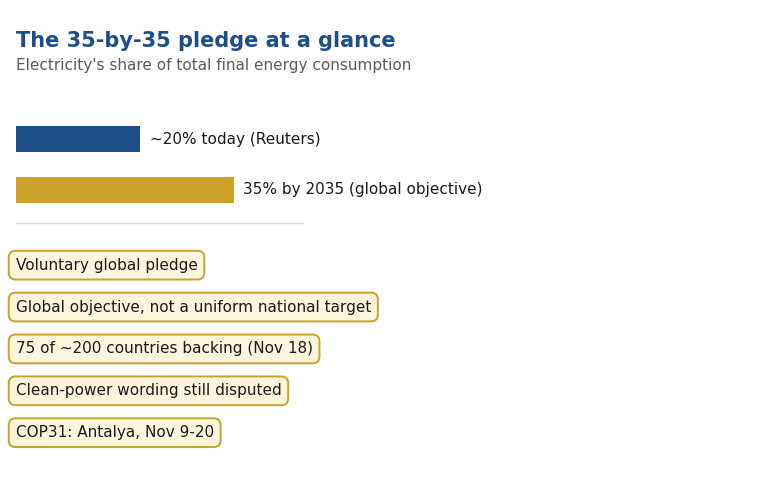
The host's centerpiece is the "35-by-35 Global Electrification Pledge": a voluntary global objective to raise electricity's share of total final energy consumption to 35 percent by 2035. It is not a uniform national target: participants retain authority over their own policies and pathways. Reuters reports the starting point as around 20 percent; Bowen has put the current share at 23 percent. As of November 18, 75 of the nearly 200 countries attending had backed the pledge, according to the hosts. [1,3,5]
The fight is over one word: clean
The pledge recognizes Paris-aligned pathways and says the objective complements renewable energy and energy-efficiency efforts. It does not, however, require all additional electricity to be clean. Its text leaves electrification pathways and the use of clean electricity to different national starting points and circumstances. That leaves room for fossil-fired generation within the global target. [3,5]
The stakes are quantified, and contested. Analysts cited by ABC estimate that reaching 35 percent using only clean energy could cut the projected level of global warming - at least 2.6C under current government policies - by 0.3C; that is an analyst estimate, not a pledge commitment. Supporters note the target means electrifying at four times the current pace. Sceptics argue that electrification built on fossil fuels locks in their prolonged use. Australia is separately pressing for an agreement to double the number of households with rooftop solar. [3]
OPEC answers from the plenary
OPEC Secretary General Haitham Al Ghais told the plenary on November 18 that electrification "is not the only solution to the world's environmental challenges." His argument: the build-out itself runs on oil. "Grid expansion requires more petroleum-derived products and diesel-powered heavy machinery," he said, adding that increased electrification carries risks including cyberattacks on energy systems and the supply of critical minerals. "We will require all energies for energy security... to achieve sustainable development goals... to accommodate differences in national circumstances." [1]
The intervention fits a pattern. At COP28 in Dubai, OPEC called on OPEC+ members to reject any negotiated text targeting fossil fuel use rather than emissions; that conference settled on language about transitioning away from fossil fuels without committing to a phase-out. [1]
The host's compromise position
Turkiye's own energy system relies heavily on fossil fuels, and it proposed the electrification pledge as a way around the protracted direct battles over fossil fuel language that have consumed past conferences. In his opening address, Kurum framed climate targets as investment programs: "Targets must be backed by budgets. Budgets must bring projects to life." [1,3,4]
Analysis: a global electrification-share target gives governments a shared number while leaving national pathways open. That breadth can attract support across different grid mixes, but the emissions outcome still depends on how the additional electricity is produced. The final wording and signatory count remain worth watching before the scheduled Friday close; previous COPs have overrun. [1,5]
What it means for energy business
Analysis: the pledge identifies grids, storage and system flexibility as enabling investments and calls for stronger financing and project pipelines. Those are areas for energy businesses to watch, not promised contracts or a forecast of orders. [5]
Analysis: OPEC's remarks also point to supply-chain dependencies, including critical minerals and grid cybersecurity. The pledge does not specify the generation mix that will supply additional demand. It cannot by itself establish future gas, LNG or equipment sales. [1,5]
Sources and credits
Sources checked November 18, 2026. Educational reporting and labeled analysis, not investment, legal or policy advice. National targets, pledge language and the 0.3C figure are attributed to their sources; nothing here is a Xyzenrgy projection or a forecast of the conference outcome.
Contact Xyzenrgy to discuss the energy questions facing your business: [email protected].